
How Bench Warrants Work in Sequoyah County
Think of a bench warrant as the court enforcing its own schedule rather than opening a new prosecution. Oklahoma Title 22 § 454 covers the situation where a person out on bail or a deposit simply fails to appear when personal attendance is required. Sequoyah County dockets often spell this out as "FAILURE TO APPEAR BENCH WARRANTY" in blunt capitals, though that is not the only trigger. Disobeying an order, leaving costs unpaid, forfeiting a bond, or contempt can all start the same machinery in Sequoyah County. What controls in the end is the exact docket and the order behind it. The warrant itself is a command, not a fresh charge. It draws on the court's authority over a case that already exists. After the warrant is recalled or served, the underlying matter can keep going, whether that means a fine, a support order, or the next setting.
How Sequoyah County Bench Warrants Are Issued
Issuance runs through the judge and the clerk. The judge directs the clerk to issue the process. The clerk then records the event in the District Court file. Under Oklahoma procedure, a District Court bench warrant can reach across one or more counties. The public docket may show the order, the bond, the fees, and any later recall or return, though the warrant image itself may sit only at the Court Clerk's office for inspection. City cases run on a separate track. Each municipal court handles its own traffic, ordinance, and FTA path. Sallisaw, Roland, Muldrow, Vian, and Gore are separate channels. A Sequoyah County city bench warrant may never show up on the sheriff's Most Wanted page, so a countywide search cannot replace a call to the city clerk.
| Trigger | What to ask | Office |
|---|---|---|
| Missed District Court appearance | Active status, bond, recall or reset | Court Clerk |
| Missed city date | Payment, new setting, judge action | Municipal clerk |
| Family or support contempt | Assigned division and hearing instructions | Court Clerk or support office |
Bench Warrant vs Arrest Warrant
The two documents come from different corners of the process. An arrest warrant grows out of criminal probable cause, often stamped "ISSUE WARRANT OF ARREST ON INFORMATION." A bench warrant grows out of a missed appearance or an order problem. Either one can end in arrest. Calling one a "capias" settles nothing about local status; the issuing court confirms both. Sequoyah County public records favor the plain terms: bench warrant, FTA warrant, warrant of arrest, recalled, and returned.
| Feature | Bench or FTA warrant | Arrest warrant |
|---|---|---|
| Common starting event | Missed setting or court-order issue | Complaint or information with probable cause |
| Public trail | FTA, bond, recall, or return entry | Warrant-of-arrest event, charge, bond, service |
| Next call | Issuing clerk, counsel, sheriff if service is asked | Court Clerk, sheriff, city police, or federal office |
Finding the Missed Date in OSCN
Start with OSCN, the Sequoyah County selector, and the case number you have. Read the whole chain, not one line: the scheduled appearance, the FTA event, the warrant entry, any endorsed bond, and later recall or return events all connect. Remember that the event date is when the clerk recorded the item, not necessarily when a deputy tried service. A blank search proves little. If nothing appears, call 918-775-4411 and ask whether the case is District Court, city court, sealed, juvenile, or simply newly filed. The County Clerk is not the criminal-file clerk. That distinction matters in Sallisaw, where the courthouse and the city offices keep different record paths. A docket with no image is not a warrant-free docket, so ask whether the document is held at the courthouse for inspection.
Resolving a Sequoyah County Bench Warrant
Resolution starts with the issuing court and nowhere else. Ask the clerk whether the judge wants a personal appearance, whether counsel can seek a recall or reset, whether payment alone is enough, and whether bond is endorsed. Sequoyah County publishes no recall form, filing fee, walk-in surrender schedule, or universal amount. Those gaps make the direct clerk call unavoidable.
- Identify the case, court, reason, and current status.
- Ask for the exact total and whether an appearance is required.
- Contact counsel or ask the court about Oklahoma Indigent Defense System intake if indigency applies.
- Confirm any jail or bondsman procedure before appearing.
- Keep the order, receipt, reset notice, and next court date.
Call first. The county does not publish a warrant-specific walk-in rule. Do not assume that paying a fee or walking into a jail will recall a judge-issued warrant.
Which Sequoyah County Court Holds the Case
The District Court of the Fifteenth Judicial District handles the county's criminal, traffic, family, juvenile, and other trial matters. The Court Clerk at 120 E. Chickasaw Avenue, Suite 205, keeps the criminal and traffic dockets. City municipal courts keep their own ordinance and traffic cases. A support matter may run through a family division or the Sallisaw Child Support office. But the court alone controls any contempt process.
District Court confirmation
Sequoyah County Court Clerk
918-775-4411
Criminal and traffic docket route
County service and custody
Sequoyah County Sheriff's Office
918-775-9155 dispatch
Jail 918-776-9028
Bond Paperwork Has Its Own Rules
Bond paperwork in Sequoyah County has its own rules, and the sheriff's bondsman page states them plainly. The paperwork must be complete and notarized. It must carry the case number when the case has been filed. Defects can mean rejection or re-arrest, so the details matter. The page stops short of publishing every accepted payment type, a bond-window schedule, or a warrant-specific amount. OSCN maintains an index of Uniform Oklahoma Fee and Bond Schedules, but a schedule index is not a Sequoyah County case calculator. The court sets the real terms. It may set the amount, allow a personal-recognizance route, require a surety, or order a hold. Before choosing any bond path, ask the issuing court or the jail for the live instruction.
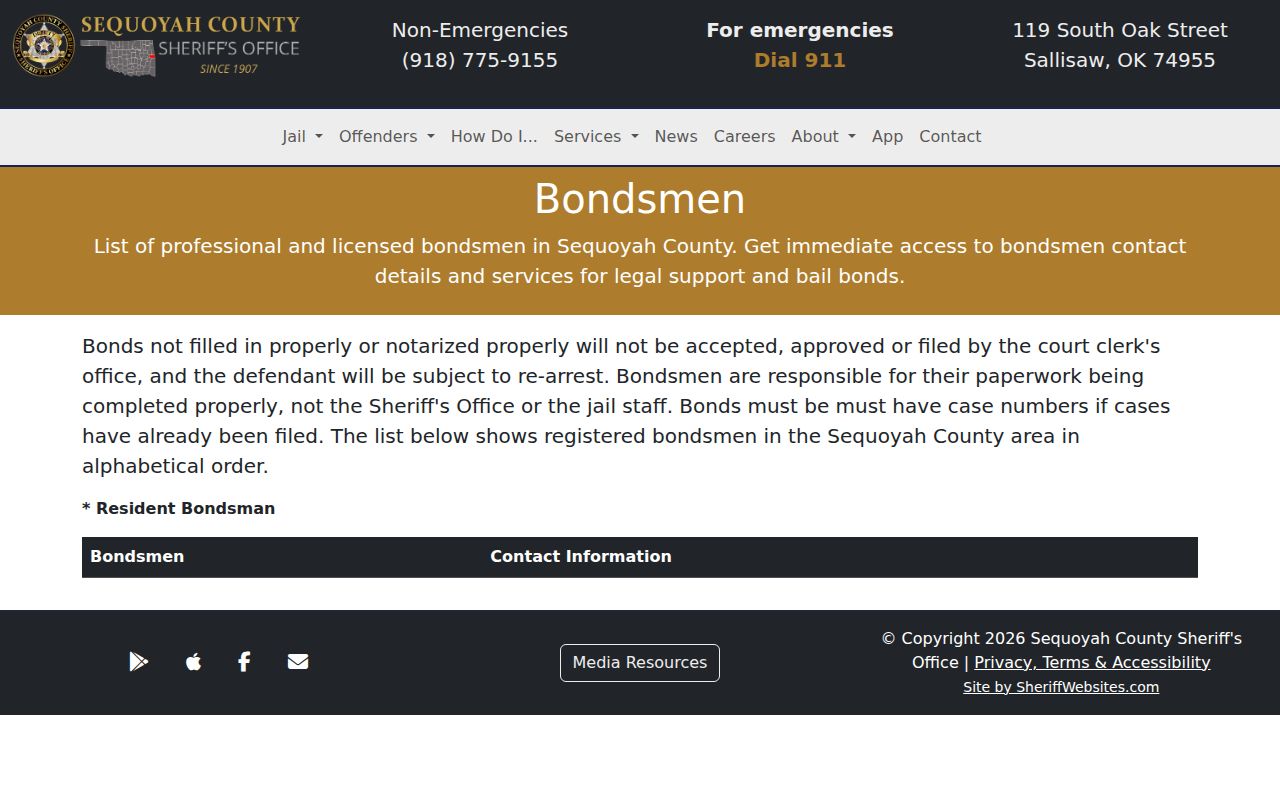
The sheriff's own bondsman page is the official source for Sequoyah County bond paperwork rules. Read it as a warning, not a published quote.
For the fee-and-bond index itself, OSCN's official schedule page carries the current documents. Confirm the effective one, then ask about the specific Sequoyah County case.
Records Requests and Bench-Warrant Proof
The sheriff's Records Division takes in-person requests on weekdays from 9 a.m. to 3 p.m. It posts no dedicated bench-warrant form and no exact warrant-record fee. A District Court event belongs with the Court Clerk. A sheriff-held incident or service record may go through the Records Division instead. Ask for the docket entry, the order, the return, or another releasable record rather than a complete public roster.
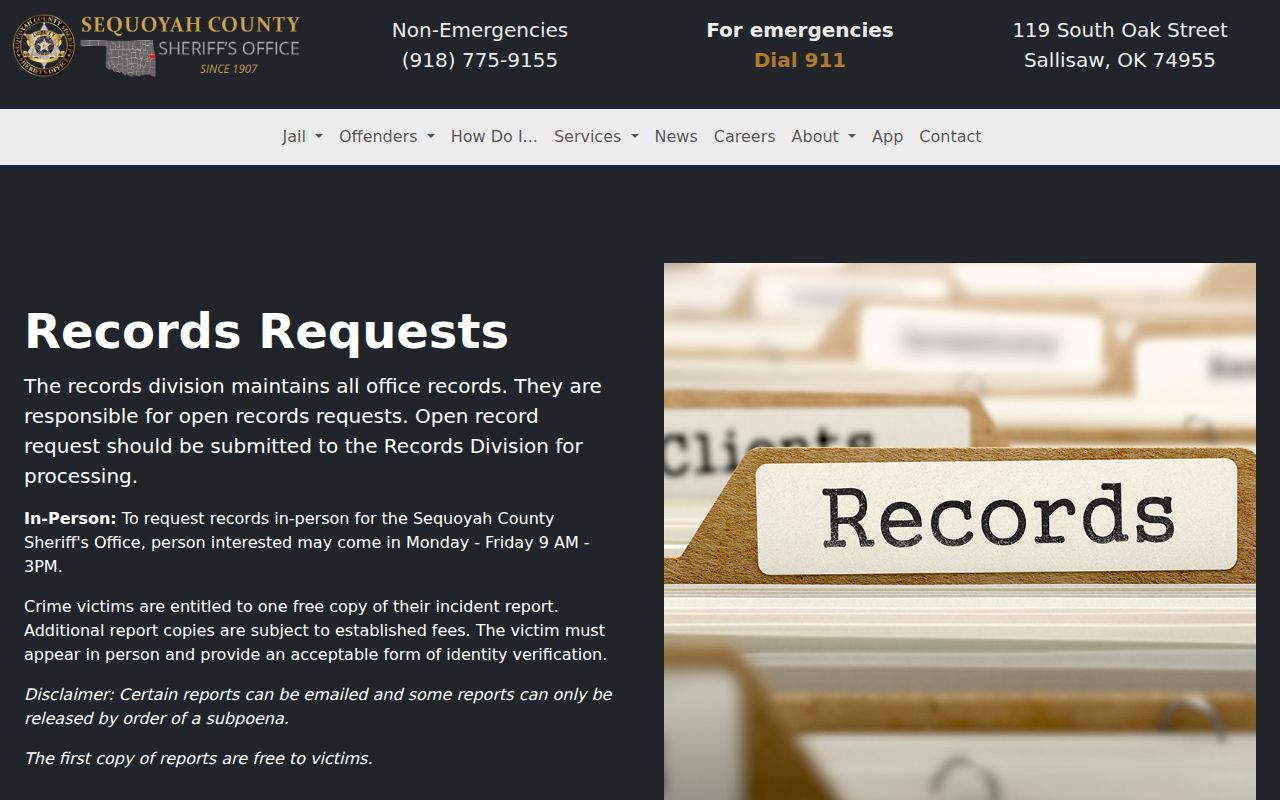
For its request instructions, the Sequoyah County sheriff publishes the details on its records page. Those hours are not surrender appointments.
After Recall, Keep Watching the Case
A recall is not the finish line. The bench warrant may be gone, but the case usually keeps going. Costs may still be owed, a reset date may be set, and probation or support terms still have to be followed. The original charge does not vanish either. Ask the issuing court when OSCN and the serving agency will show the update. Keep proof of whatever the court did, then check the next setting. For the wider county route, use the Sequoyah County warrant records home page; for a traffic or city failure to appear, contact the issuing municipal court before sending any payment. In Sequoyah County, a safe resolution means a confirmed court action, not just a changed web label.
Family Support Bench Process Needs Its Own Desk
A support contempt or appearance matter belongs with the Sequoyah County District Court family or support route, not a city traffic vendor. The Sallisaw Child Support office serves Sequoyah and Adair counties. The county itself runs no support-warrant portal. Ask the Court Clerk which division and hearing control the case.